BEVA's Portable Tire Inflator: Handy Auto-Stop Pump, Tiny Review Base

It's a cold morning, you're already late, and the tire pressure warning light blinks on as you back out of the driveway. You know the drill from here. Find a gas station with a working air machine, dig for quarters or an app, squat next to the wheel guessing whether you've put in enough. Or maybe your version is different:
- The road bike tire that's gone soft in the garage the night before a weekend ride, and the floor pump is at your mate's place.
- The slow leak on the family car that needs a top-up every couple of weeks, and every top-up means a detour.
- The basketball, the air mattress, the pool float, all of which need air exactly when nothing around you provides it.
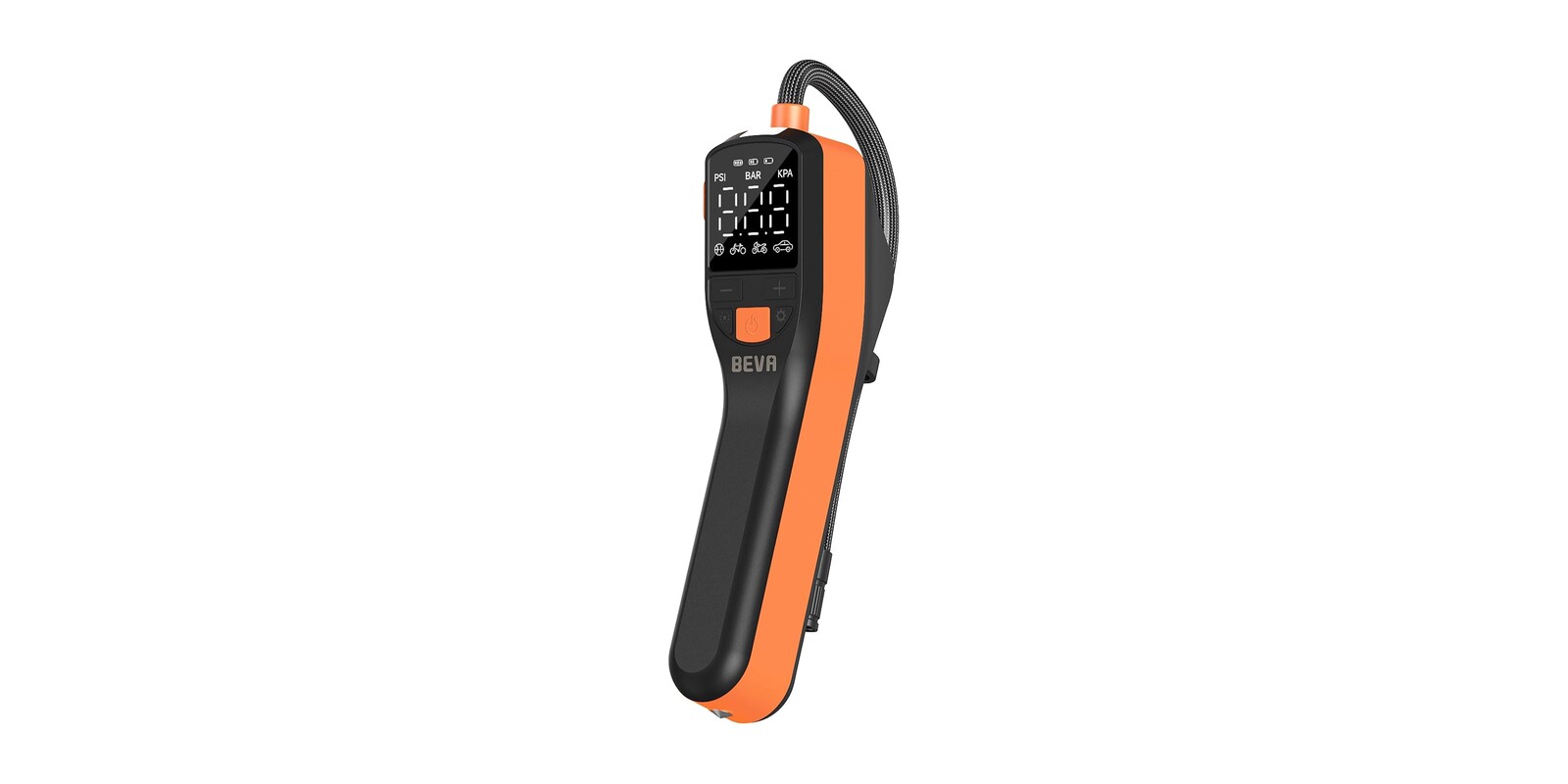
The BEVA portable tire inflator is a cordless, glove-box-sized answer to all of those scenes. It's a battery-powered air compressor with a digital gauge, an auto-stop function, and a built-in LED light. On paper it's a genuinely useful little machine. In practice, early testers seem to agree. But we do mean early, and we'll get to that.
What You're Actually Getting
This is a handheld, USB-C rechargeable inflator rated to 150 PSI max with 23 liters per minute of airflow. BEVA's own numbers: a 195/65R15 car tire goes from 30 to 36 PSI in about a minute, and a 700x25C road bike tire goes from empty to 120 PSI in under two. It's rated for 20 minutes of continuous running, weighs just under a pound, and comes with a storage pouch, a charging cable, and adapters for Schrader, Presta, and Dunlop valves plus balls and inflatables.
There are four presets (car, motorcycle, bike, ball), a big digital display that switches between PSI, BAR, and kPa, and an LED light with flashlight and strobe modes that works even when the pump is off. The bottom of the unit tapers into a hard cone that doubles as a car window breaker, which is a slightly grim but sensible thing to build into a roadside tool.
Using It: The Whole Job in Five Steps
The reason this category of tool has taken off is that the workflow is nothing like wrestling a 12V compressor cable through your car window. Here's the actual sequence, pieced together from the manual details early owners describe:
- Charge it before it goes in the glove box. One tester reported the first charge took most of a day, so don't buy it the morning of a road trip. Top-ups after that are quick; another owner saw the indicator go from blinking to done in 15 minutes after a light session.
- Screw the hose onto the valve stem. It threads on rather than clipping, so it stays put and doesn't hiss air while you fumble.
- Pick a preset and dial in your target. Hold the power button to switch on, tap the gear button to cycle car, motorcycle, bike, or ball, then fine-tune with the plus and minus buttons. The defaults are sensible starting points (36 PSI for cars, 8 for balls).
- Press go and stand up. The pump runs until it hits your target pressure, then shuts itself off. No babysitting, no guessing, no checking with a separate gauge afterwards.
- If you overshoot, bleed it. There's a small protrusion on the bottom for releasing air if a tire's overfilled, a detail one owner found in the instructions and was glad to have.
Warm Corners tip: hard-press the light button and the compressor starts with the light already shining. One button, both jobs. If you're ever kneeling next to a wheel arch in the dark, that's the feature you'll remember.
The Auto-Stop Is the Point
Cheap inflators make you do the thinking. This one doesn't. You set 36 PSI, it stops at 36 PSI, and the display is big enough to read from standing height at night. One owner with four cars in the household said they checked and adjusted eight tires on a single charge with battery to spare. Another topped off four truck tires on an F-250 and then did four bicycle tires before the charge ran low.
The most convincing test we found came from a reviewer who deliberately emptied an SUV tire to zero to see if this little thing could handle a genuinely flat 315/35R20:
"It took about 25 minutes, but it got the job done. After 25 minutes non-stop in an 80 F garage, the unit was about 120 F on the outside, which isn't bad at all. There was about a third of the battery left too."
That's a worst-case scenario for a pocket compressor, and it passed. Slowly, and warm to the touch, but it passed.
The Honest Caveats
First, the big one. This product has 16 ratings. Sixteen. And every written review we could find came through Amazon's Vine program, which means the reviewers received the unit free in exchange for their opinion. Vine reviewers are often thorough (the flat-tire torture test above is exactly the kind of thing they do), but a review pool this small and this uniform is a young signal, not a track record. Nobody has owned this pump for a year yet. Nobody knows how the battery holds up through a winter in a cold trunk.
A 4.8 average from 16 people tells you the first testers liked it. It cannot tell you what breaks in month eight. If you need a proven tool with thousands of long-term owners behind it, this isn't that yet.
The smaller stuff, from the reviews themselves: it gets hot in your hand during extended use, and one tester took breaks to let it cool. The inflation hose is built in and can't be replaced, so if the hose fails, the unit fails. The manual says that if you let the battery run completely dead, you can't use the pump while it's charging, so a forgotten, drained unit won't rescue you the moment you plug it in. And the first charge is slow enough to plan around.
Where It Lands
| Going for it | Against it |
|
|
Is This the Right Tire Inflator for You?
You'll love it if you are...
- 🚗 A commuter who wants the warning-light detour gone for good, with a pump that lives in the glove box
- 🚴 A cyclist who needs 120 PSI in a road tire without a floor pump, with Presta support out of the box
- 🧳 A road tripper or parent of a new driver who wants a self-stopping, idiot-proof emergency tool in every car
- 🏀 A household where tires, balls, and inflatables all need air and nobody knows where the hand pump went
Skip it if you need...
- A tool with a long, proven ownership record. This one is weeks old on the market
- A shop-grade compressor for frequent full inflations. The duty cycle and heat make this a top-up tool first
- A replaceable hose or serviceable parts. When any piece of this fails, the whole unit does
Review Base at a Glance
4.8 stars from 16 ratings, and the written reviews are all Vine free-product reviews. That's a promising early signal, not a verdict. The testers who have it praise the auto-stop, the readable display, and the fact that it actually inflated a dead-flat SUV tire, and the only recurring complaints are heat during long runs and the slow first charge. We'd call it a well-designed newcomer that hasn't earned a reputation yet, because it hasn't had time to.
As an Amazon Associate I earn from qualifying purchases. This comes at no extra cost to you.
You should also read:
The Coleman RoadTrip 285 Is a Genuinely Good Grill. "Portable" Comes With an Asterisk.
Every tailgate lot and campground has the same two grills. There's the sad little tabletop unit that fits one round of burgers if you stack them, and there's the guy who somehow wedged a full-size backyard grill into a pickup bed and now can't get…
Continue reading...Can a Shaker Bottle Really Taste Like Texas Roadhouse? Rattlesnake Seasoning, Reviewed
Y ou've had the appetizer. Maybe you waited forty minutes for a table, ordered the Rattlesnake Bites to keep the kids quiet, and then quietly ate most of them yourself. Spicy, cheesy, a little sneaky on the heat. Then you go home, cook a perfectly…
Continue reading...Garmin Instinct E Review: A Rugged GPS Watch That Trades Polish for Patience
You're a few days into a trip with no outlet in sight, and the watch on your wrist still hasn't asked for a charger. That's the quiet thing most smartwatches can't do, and it's the exact reason a watch like this exists. Forget the glossy…
Continue reading...